Benchmark results¶
Cost and runtime of the zagg compute pipeline on AWS Lambda over the NEON SERC AOP box, tracked as two cadences (issue #250 restructure, espg-approved on PR #256):
- Per release — full-AOI truth. Every shard over the
AOP_NEONbox, once per version tag: the point pipeline (ATL03 t-digest) and the raster pipeline (Sentinel-2, year 2025). - Per commit to
main— regression tracking. The single densest shard of one pinned configuration, so deltas track code changes, not data drift.
All runs: arm64, 4 GB worker, o9 dispatch shards, tdigest (point
pipeline), granule_workers=4. Costs are reported for the full run — no
per-100 km² normalization (dropped from all rendered outputs; the
cost_per_100km2_usd column stays in the parquet history). Charts render on
merge/release to the benchmarks data branch and embed here by raw URL (no
docs rebuild). See Lambda benchmark CI/CD setup for the
wiring.
Per-release benchmarks (full-AOI NEON)¶
Two release legs (lambda-benchmark-fullaoi.yml, tag-triggered):
- Point pipeline (
targets_full_aoi_neon.json, one target) — o9, hive store layout, sharded, tdigest, inline read, with the strict AOI binary mask. Dispatched withprofile=True, so the worker phase split lands infull_aoi_series.parquet. - Raster pipeline (
targets_raster_neon.json, one target) — Sentinel-2 Collection-1 L2A over 2025 (the pinned Earth Search catalogcat_s2_neon_2025.parquet, 85 items — offline, fixed across releases), o9 shards, pull-NN(time, cells)ingest. The harness (run_raster_benchmark.py) dispatches throughagg(profile=True)— the runner's raster path threads the profile key to the workers and rolls their stage timings, billed durations and peak RSS into the summary — and retains its ownraster_series.parquet. The dispatch is invoke-only end to end (issue #264): after the issue #252 preflight ping, the(time, cells)template is written by a synchronousmode="setup"Lambda invoke before fan-out — recorded astemplate_s, the raster analogue of the point path'ssetup_s— so the leg runs cleanly under thezagg-benchmarkOIDC role's no-S3 grant (the "template write happens inside the Lambda" invariant in Lambda benchmark CI/CD setup now holds for both legs). Two deviations from the target end-state: the live target still pinsstore_layout: flat— raster + hive is now legal and is the defaulted profile (issues #247/#253: an unpinned healpix raster config writes hive leaves), so the manifest'spending_targetshive variant is unblocked and awaits promotion as a deliberate benchmark-manifest change — and no strict AOI mask (issue #101 is point-path-only); the AOI scoping is the catalog's STAC-query clip.
Summary — total billed cost and wall time¶
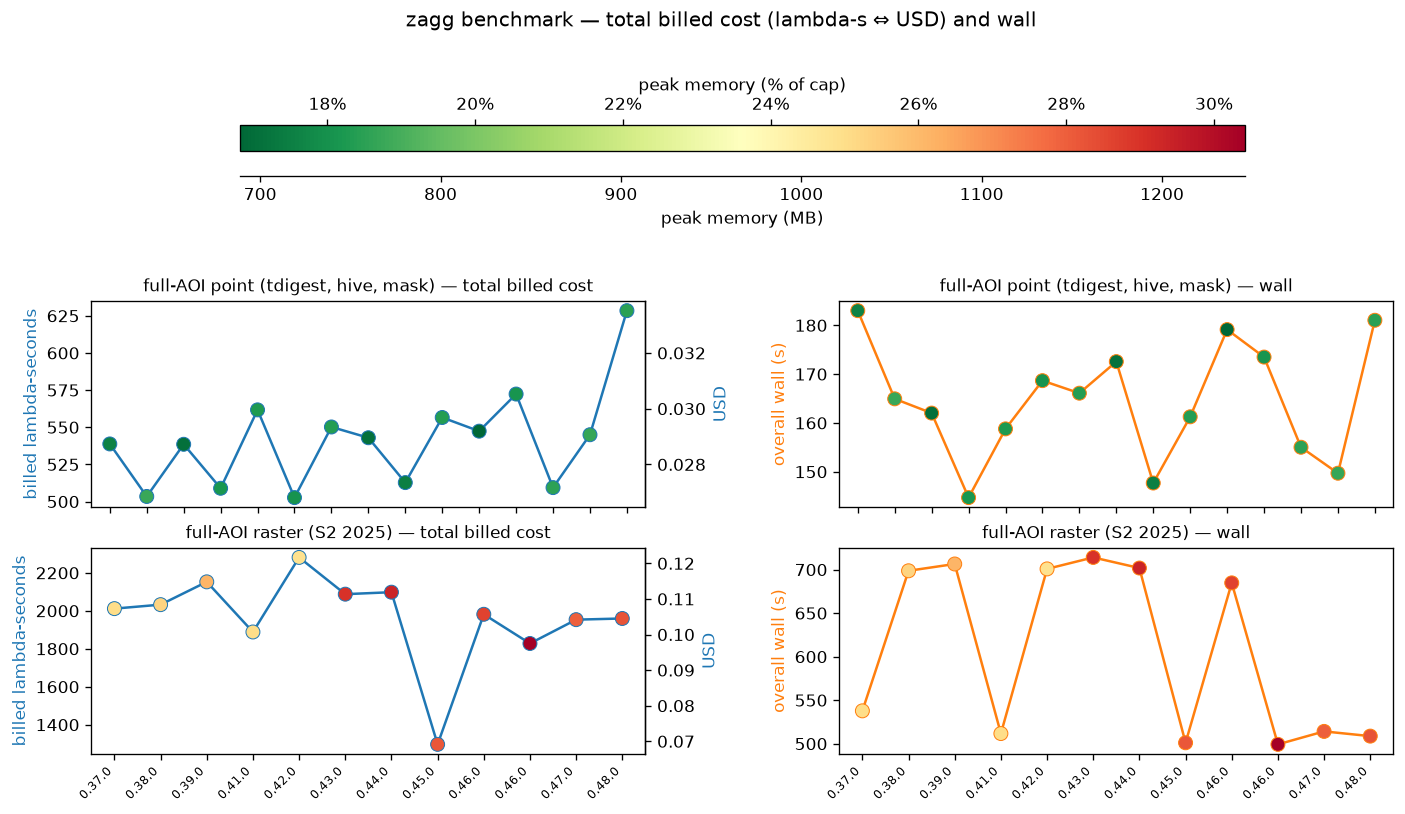
One row per pipeline: total billed cost on a dual axis — billed lambda-seconds (left) and USD (right, an exact relabeling at the fixed 4 GB price) — and overall wall, against the release tag. Markers on both rows carry the peak-RSS colour scale (green→red % of the 4 GB cap, MB twin axis): the raster worker reports the same sampled per-invocation peak as the point path (issue #141 convention; raster parity added by issue #250).
The point pipeline's dollar figure is the summed total:
cost_usd + setup_cost_usd + finalize_cost_usd. The sync setup and finalize
invokes are billed but excluded from the worker-GB-seconds cost_usd, so the
sum is the honest whole-run figure; the three stay separate columns in the
series so the retained cost_usd history remains comparable (see
"Cost columns" below).
Diagnostics — point pipeline per-phase seconds¶
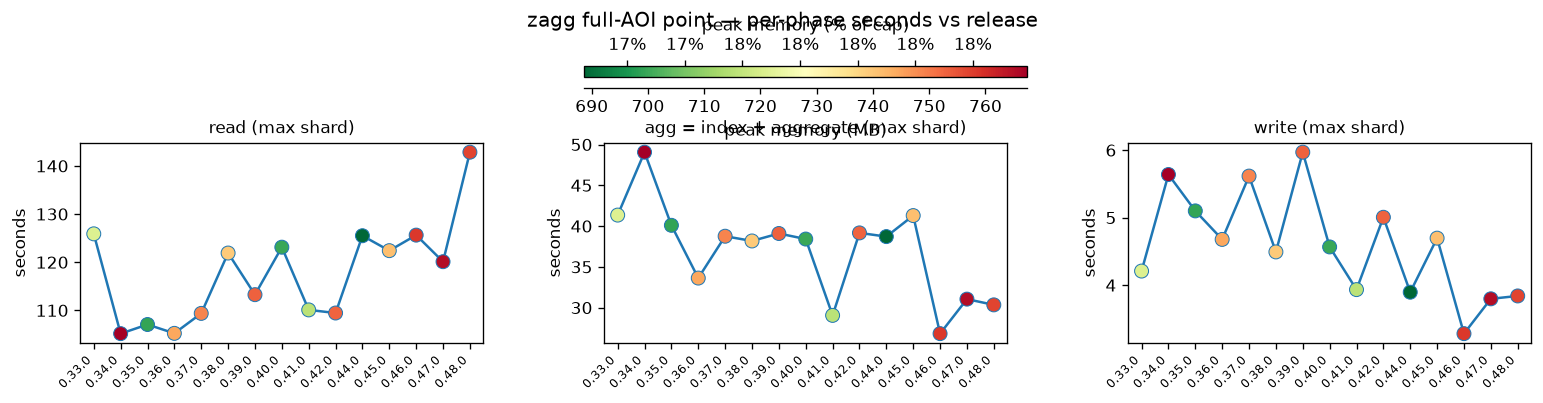
One panel per phase, seconds (straggler max across shards, matching the wall framing) vs release tag — never stacked:
- read / agg / write — the worker split emitted under
profile=True(worker_phase_max). The displayed agg = index + aggregate (the espg-approved mapping); the series retains the raw emitted phases (phase_index_s,phase_aggregate_s, plus the PR #256writesplit) so the display mapping can change without rewriting history. - setup — the sync setup path. On flat it was the fullsphere-template
invoke (~104–110 s, the
docs/design/sparse_coverage.md§1 waste); on hive (the issue #252 hybrid) it is only the preflight ping + ~10 ms async Event dispatch of the manifest write, so the flat→hive migration reads as a visible collapse of this panel. - finalize — kept per issue #252: ~0 on flat, but on hive the load-bearing
idempotent
morton_hive.jsonmanifest backstop (the async init write runs with retries 0; finalize self-heals a lost manifest).
Phase cells are null on releases recorded before a capture landed, so panels simply start at the first release that recorded them.
Diagnostics — raster pipeline per-stage seconds¶
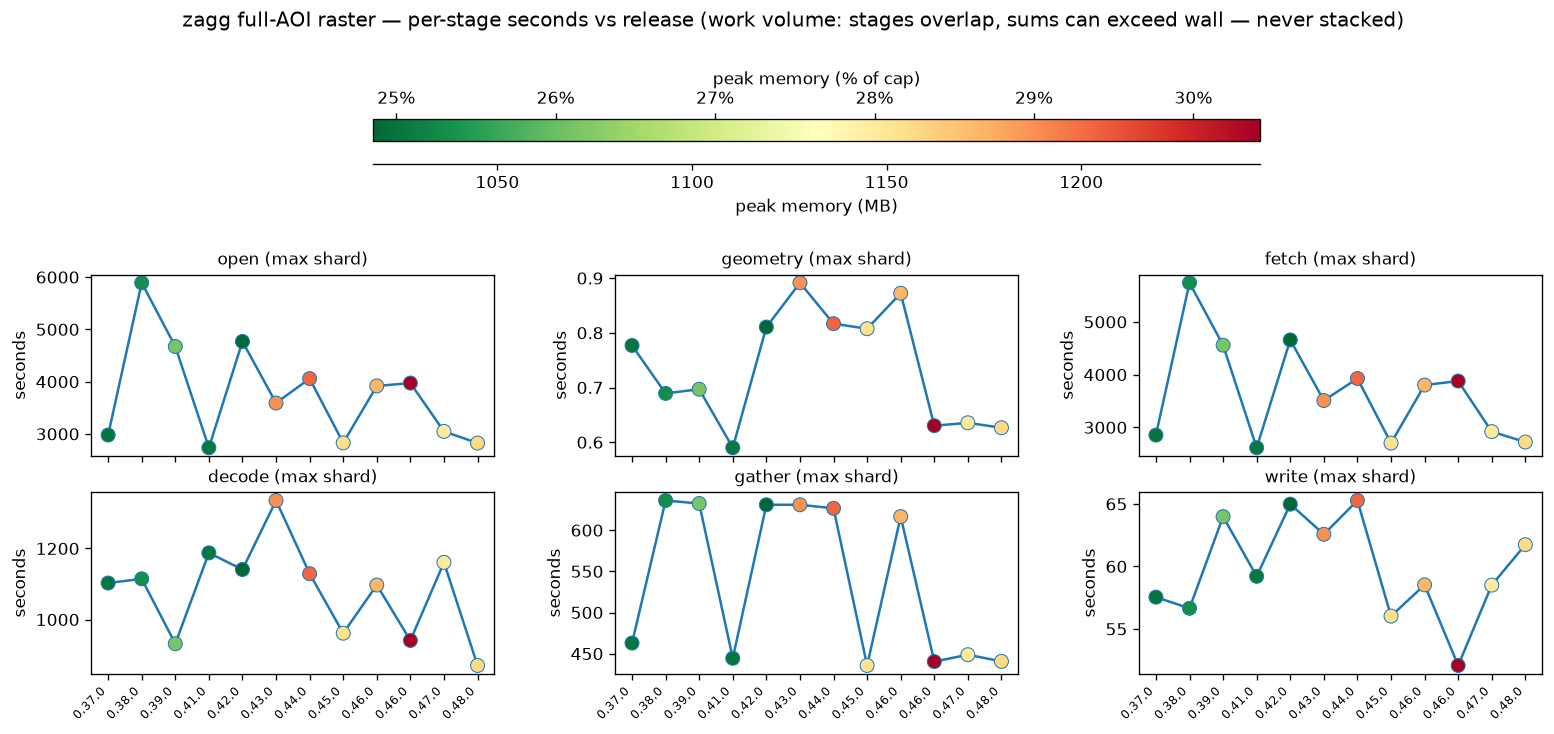
The issue #249 stage set — open (store lookup + TIFF headers), geometry
(pull-NN mapping; geom-cache hits ≈ 0), fetch (tile GETs), decode,
gather (tile-index derivation + scatter/gather) — plus the worker write
bucket, each as its own panel (max shard) vs release tag.
Stage seconds are work volume, not a wall decomposition: concurrent
asset-samples overlap on one event loop, so stage sums can exceed wall. The
panels therefore show each stage as its own series and are never stacked to a
wall total. The series also records run-total work counts
(count_assets / count_tiles / count_geom_hits).
Store object count (issue #240 tripwire)¶
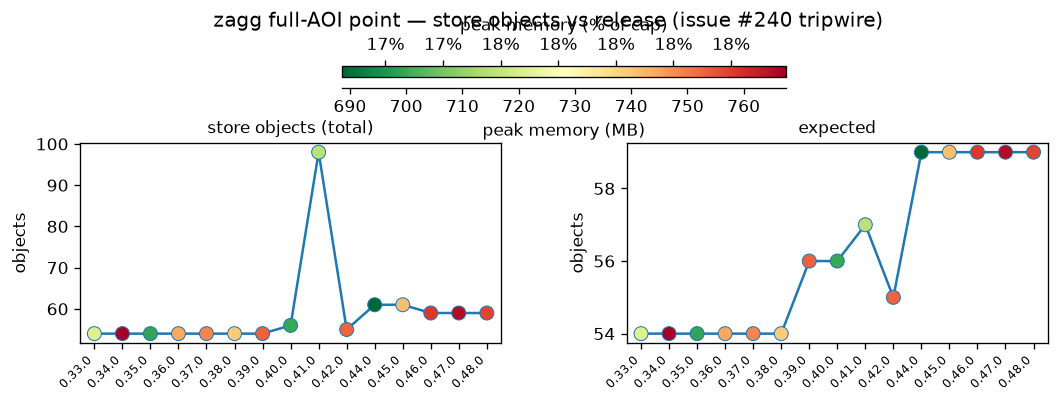
The output store's object total vs the config-derived expectation, per release. A sharded-write bypass multiplies the count ~K-fold (the issue #215 blow-up), so a write-path regression reads as a step here. Record-only on the release leg (a flaky release is never blocked on it); the per-merge harness hard-fails on the same mismatch.
What the audited total does not include (issue #362): the second-pass sweep
caches (rollups, overview zarrs) and per-run root telemetry — the run stats
parquet and sweep run record, whose names are unique per run. Those are tallied
in their own buckets and reported (objects_telemetry on the record), never
audited; the store path is scoped by commit so the write-path objects a run
counts are only its own.
Cost columns¶
cost_usd is the workers' billed GB-seconds — its semantics never change, so
the retained history stays comparable. The sync orchestrator invokes get their
own columns at the same fixed price: setup_cost_usd (setup_s × 4 GB ×
$/GB-s; on hive rows setup_s is only the ping + async-dispatch residue —
the fire-and-forget manifest write's billed GB-s is unobservable from the
orchestrator and is never invented) and finalize_cost_usd (same pattern
for the finalize invoke). The summary chart displays the sum; the parquet
keeps the parts.
Per commit to main¶
Single densest shard from the NEON AOI, one configuration only (issue
250 collapse): o9, hive, sharded, tdigest, inline read, no AOI mask,¶
granule_workers=4, 4 GB — the former inline/sidecar × AOI-mask 2×2 is
retired to the archived section. The live target doubles as the
write-path regression arm: the object-count tripwire hard-fails the merge
run on a sharded-write bypass. Runs with profile=True, so the same
read/agg/write phase split lands in series.parquet.
Latest merge¶
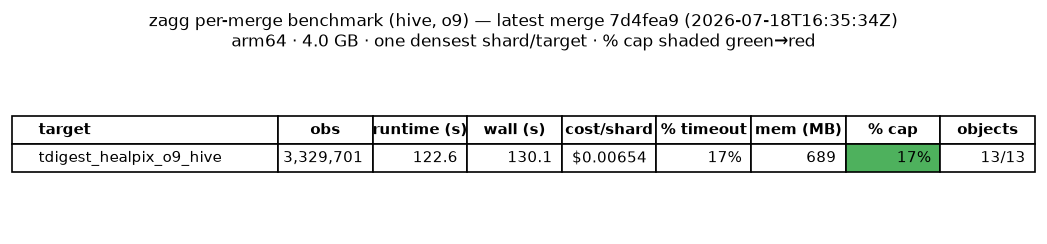
Referencing these numbers programmatically? Pull the machine-readable
companions instead of scraping the image:
metrics.json
(the latest merge's records) or
latest.md
(the same table as markdown). The full retained history is series.parquet
(per-merge), full_aoi_series.parquet (per-release point) and
raster_series.parquet (per-release raster) on the
benchmarks branch.
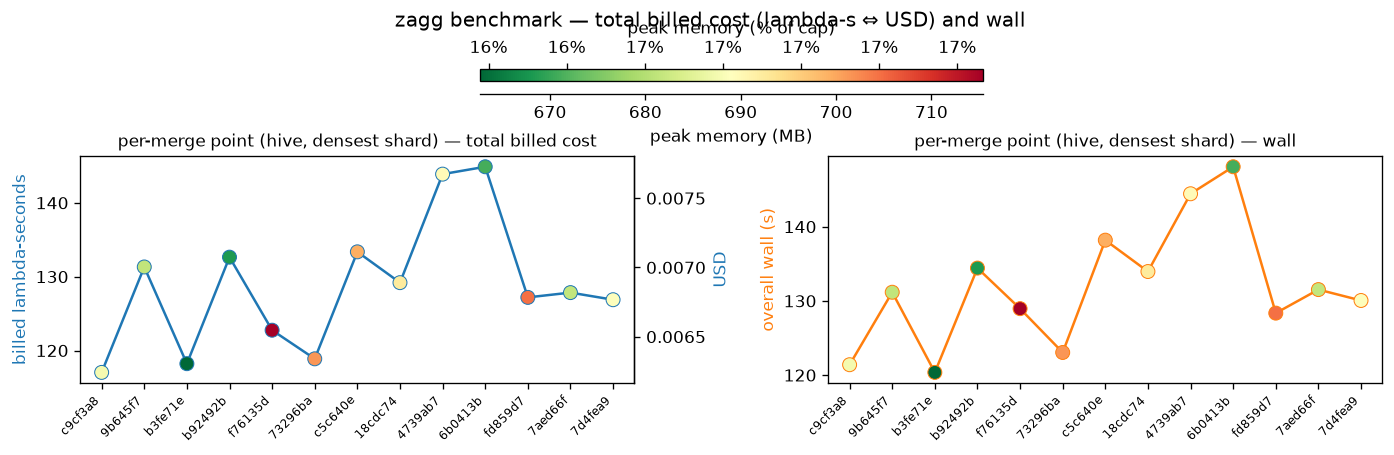
Summary — total billed cost and wall time¶
Same dual-axis convention as the per-release summary (billed lambda-seconds ⇔
USD, exact relabeling; memory-coloured markers), merge sha on the x-axis. The
total derives the sync-invoke dollars from setup_s/finalize_s at the fixed
price and adds them to cost_per_shard_usd.
Diagnostics — per-phase seconds¶
The same read / agg / write / setup / finalize panels as the per-release point diagnostics, against merge history.
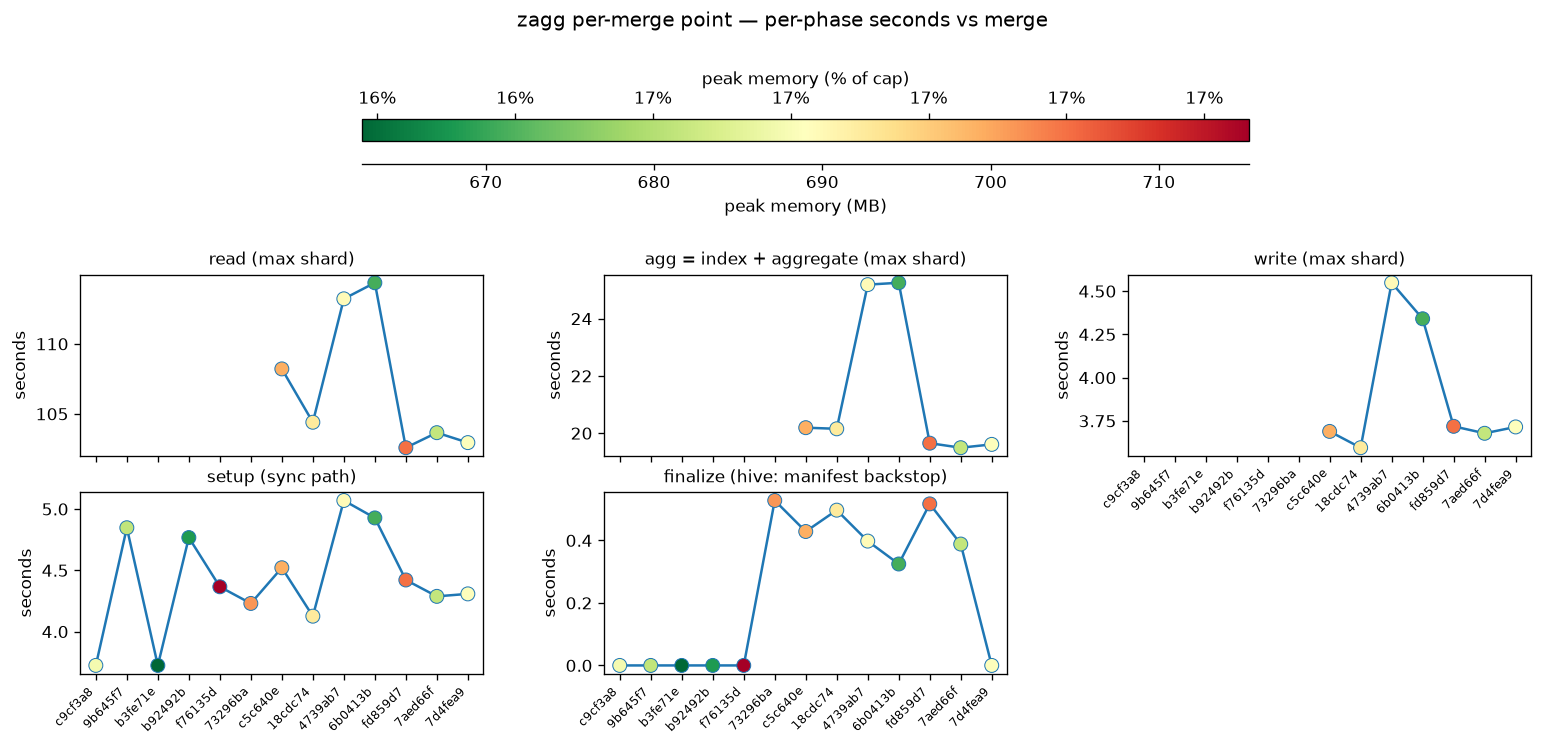
Images appear after the first post-restructure merge/release renders to the
benchmarksbranch; until then GitHub shows a broken-image placeholder.
Container regime¶
Benchmark points run with the default force_cold=False, so they measure the
warm regime — the same reused containers a routine fleet sees. Since issue
171 each run's summary carries container telemetry (worker_cold_starts /¶
worker_warm_starts / worker_rss_start_max_by_gen, rolled up from the
per-worker container_cold / container_generation / rss_start_mb envelope
fields), so a memory outlier can be stratified by whether its shard landed on a
fresh or a reused (higher-generation) sandbox. agg(..., force_cold=True)
remains the explicit all-cold certification baseline (it needs
lambda:UpdateFunctionConfiguration on the caller — see
Warm-container memory and self-recycle).
Archived¶
Retired series and figures are retained on the
benchmarks branch (and
embedded at the bottom of the published Pages index) but no longer
regenerated:
- inline/sidecar × AOI-mask 2×2 (issues #193/#202, retired by the issue
#250 collapse) — its four per-merge targets stay runnable on demand via
/benchmark --targetfromprovisional_targets; the retired full-AOI 2×2 and parity arms' rows remain infull_aoi_series.parquet. - Cost per 100 km² figures (per-area normalization dropped, issue #250 item 7).
- Sharded vs inner-chunk codec matrix (issue #133, frozen as of #193) and the pre-#133 rect/gain_bias historical matrix — the pre-existing archived tiers, unchanged.