Overview
xOPR is a Python library for working with data products from Open Polar Radar’s data archives. xOPR is designed make working with radar sounder data easy, scalable, and reproducible.
xOPR offers access to most of the OPR data catalog, but not absolutely every line. Check out our availability maps for details.
Installing xOPR
To install xOPR, use:
pip install xoprOr, using uv (our recommendation!):
uv add xoprGetting Started
Minimal example of loading and plotting a single frame of radar data:
import numpy as np
import xopr

opr = xopr.OPRConnection()

stac_items = opr.query_frames(collections=["2022_Antarctica_BaslerMKB"], segment_paths=["20221228_01"], max_items=1)
frames = opr.load_frames(stac_items)

(10*np.log10(frames[0].Data)).plot.imshow(x='slow_time', y='twtt', cmap='gray', yincrease=False)
For a more complete getting started guide, see getting started. Or jump in by checking out some of the notebook on the left.
Design
For current design and terminology, see the design notes page.
API Reference
Full API documentation for all xopr modules is available in the API Reference.
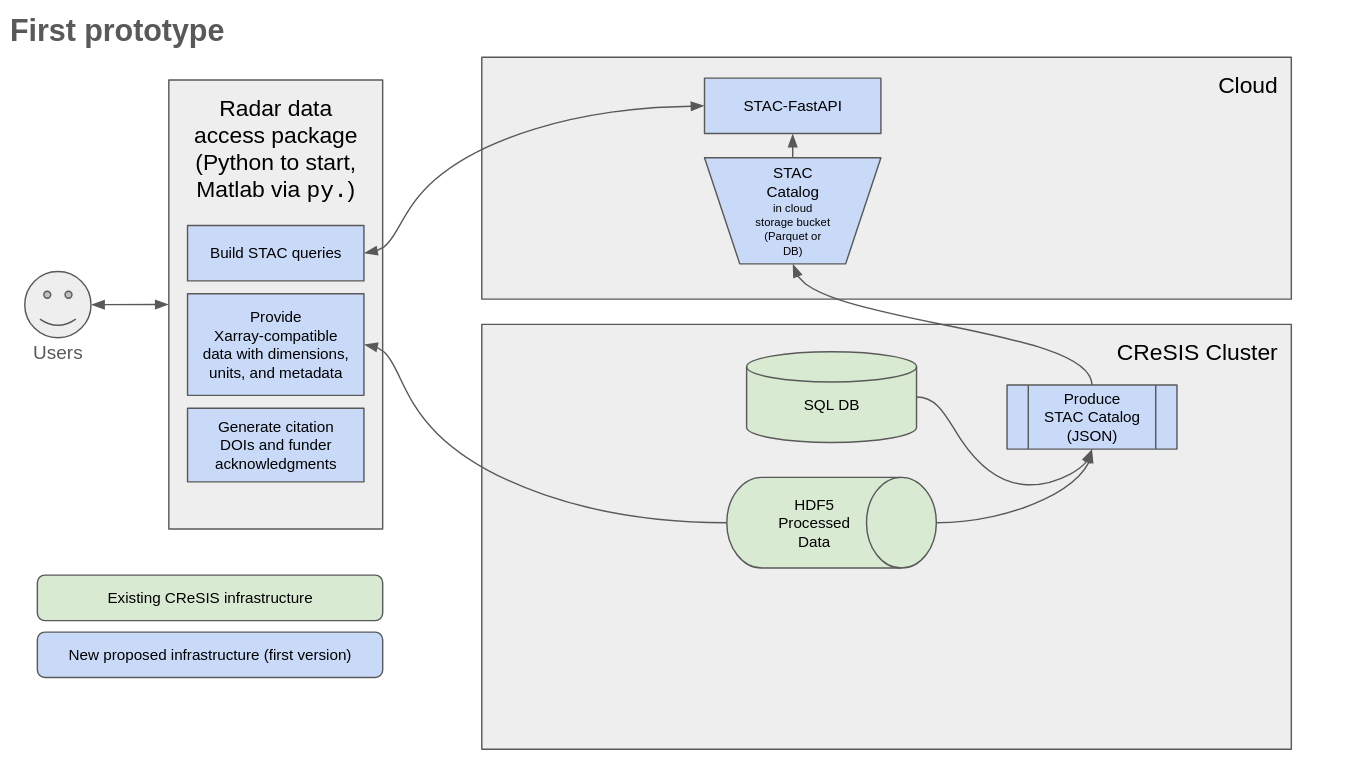
xOPR acts as an interface to OPR data. It has two primary roles: helping create queries to the OPR STAC catalog to find data and returning radar data in the form of an Xarray Dataset.
About
xOPR was originally written by Shane Grigsby and Thomas Teisberg, with extensive input from John Paden. The ongoing development of xOPR is supported by the Astera Institute as a project of Englacial.
The current maintainer is Thomas. You can reach him at thomas